 DataSheet
Award Winning Solutions
Xena has won multiple global awards for price/performance and technical innovation. Learn more.

Technical Expertise
Copyright © 2009-2024 Teledyne LeCroy Xena ApS, Denmark

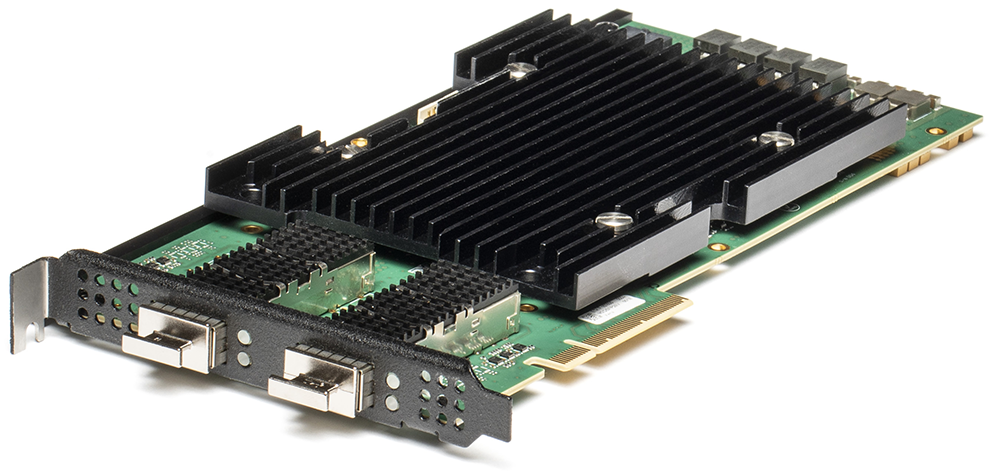
Z400q Thor is a 7-speed (400GE, 200GE, 100GE, 50GE, 40GE, 25GE, 10GE) dual media test module that can test both PAM4 and NRZ speeds.
7-speed dual-media test module
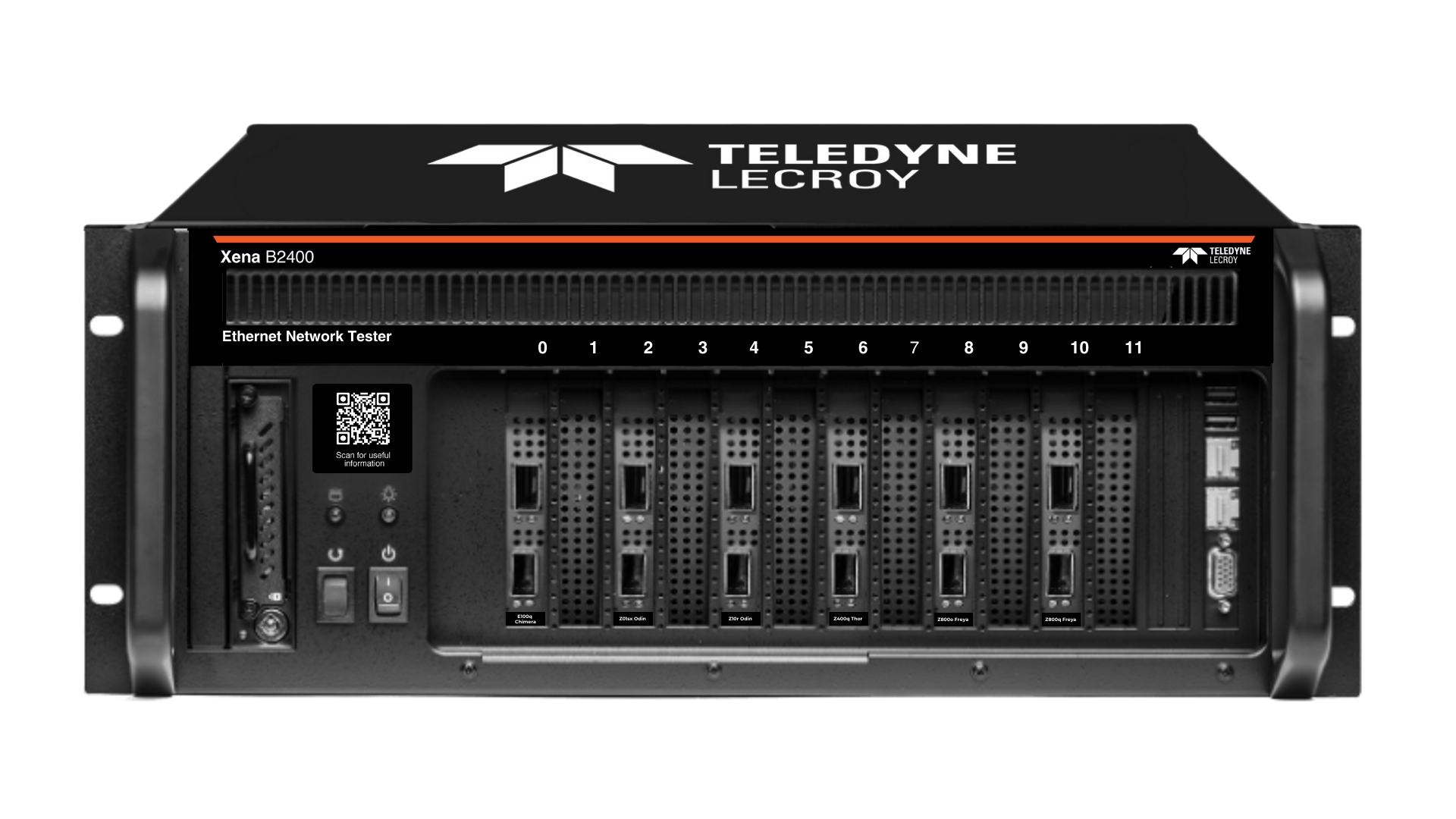
Z400q Thor is a 400Gbps Ethernet traffic generator for testing both PAM4 and NRZ traffic. It can test seven Ethernet speeds: 400GE, 200GE, 100GE, 50GE, 40GE, 25GE and 10GE, as well as Auto-Negotiation and Link Training (AN/LT). This module is exclusively available in the B2400 chassis and requires 2 slots.
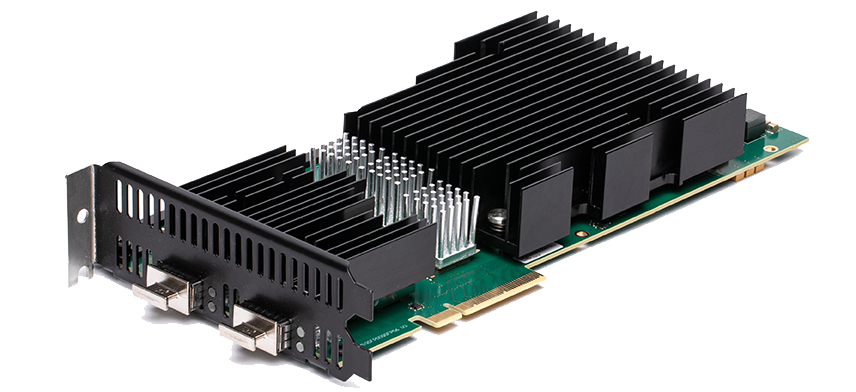
This flexibility is provided via two physical transceiver cages – one supporting QSFP-DD/56/28/+ transceivers, and the other supporting QSFP56/28/+ transceivers. Both cages can be active simultaneously – except when the QSFP-DD cage runs 400GE, 2 x 200GBASE-CWDM4, 1 x 200GBASE-SR8, 4 x 100GBASE-DR or 8 x 50GBASE-SR/CR.
The Z400q Thor supports the Ethernet standards 802.3bs and 802.3cd, as well as legacy standards.
The result is a highly versatile solution for performance and functional testing of network infrastructure and Ethernet equipment that support 400GE including switches, routers, NICs, TAPs, packet-brokers, and backhaul platforms.
QSFP-DD: 400G, 200G, 100G, 50G Ethernet
QSFP56: 200G, 100G, 50G Ethernet
QSFP28: 100G, 50G, 40G*, 25GE and 10G* Ethernet
QSFP+: 40G, 10G Ethernet
* Depending on transceiver capabilities
1 x 400G
2 x 200GE
4 x 100GE
8 x 50GE
2 x 40GE
8 x 25GE
8 x 10GE
QSFP-DD cage:
1 x 400GBASE-DR4, 1 x 400GBASE-SR8/FR8/LR8, or
2 x 200GBASE-CWDM4 (dual CS connector), or
1 x 200GBASE-DR4/SR4/FR4/LR4/CR4, or
4 x 100GBASE-DR, or
1 x 100GBASE-SR4/LR4/CR4, or
8 x 50GBASE-SR/CR, or
2 x 50GBASE-SR2/LR2/CR2, or
1 x 40GBASE-SR4/LR4/CR4, or
4 x 25GBASE-SR/LR/CR
QSFP56 cage:
Same as QSFP-DD minus support for 400G speeds, 2 x 200GBASE-CWDM4, 4 x 100GBASE-DR and 8 x 50GBASE-SR/C.
Actual interface options depend on the capabilities of the inserted transceiver. Both cages can be active simultaneously except when the QSFP-DD cage runs 400GE, 2 x 200GBASE-CWDM4, 1 x 200GBASE-SR8, or 8 x 50GBASE-SR/CR. Both cages must run with the same base interface configuration (e.g. 2 x 50G).
** As defined by 25/50 Gigabit Ethernet Consortium
IEEE 802.3 Clause 73, Auto-negotiation
RS-FEC (Reed Solomon) (544,514,t=15), IEEE 802.3 Clause 119 (200/400GE)
RS-FEC (Reed Solomon) (528,514,t=7), IEEE 802.3 Clause 91 (100GE)
RS-FEC (Reed Solomon) (544,514,t=15), IEEE 802.3 Clause 108 (25GE)
RS-FEC (Reed Solomon) (528,514,t=15), 25/50G Ethernet Consortium (25/50GE)
RS-FEC (Reed Solomon) (528,514,t=7), IEEE 802.3 Clause 134 (100GE/50GE 802.3cd)
BASE-R FEC (Firecode) 2112,2080 IEEE 802.3 Clause 74 (25GE, 10GE)
1xQSFP-DD/QSFP56/QSFP28/QSFP+ and 1xQSFP56/QSFP28/QSFP+
Link state, FCS errors, pause frames, ARP/PING, error injections, training packet
All traffic: RX and TX Mbit/s, packets/s, packets, bytes
Traffic w/o test payload: RX and TX Mbit/s, packets/s, packets, bytes
Configurable from 16 to 56 bytes, default is 20B (12B IFG + 8B preamble)
Ability to adjust the effective line rate by forcing idle gaps equivalent to -1000 ppm (increments of 10 ppm)
From -100 to 100 ppm in steps of 0.001 ppm (shared across all ports)
Supported (configurable IP and MAC address per port)
System is fully field upgradeable to product releases (FPGA images and Software)
Two real-time histograms per port. Each histogram can measure one of RX/TX packet length, IFG, jitter, or latency distribution for all traffic, a specific stream, or a filter.
Enable/disable of optical laser or copper link
IGMPv2 continuous multicast join, with configurable repeat interval
• L1RX2TX – RX-to-TX, transmit byte-by-byte copy of the incoming packet
• L2RX2TX – RX-to-TX, swap source and destination MAC addresses (*only at 10G)
• L3RX2TX – RX-to-TX, swap source and destination MAC addresses and IP addresses (*only at 10GE)
• TXON2RX – TX-to-RX, packet is also transmitted from the port
• TXOFF2RX – TX-to-RX, port’s transmitter is idle
• Port-to-port – Inline loop mode where all traffic is looped 100% transparent at L1 (All rates except 400GE)
• Initial Accuracy is 3 ppm
• Frequency drift over 1st year: +/- 3 ppm (over 15 years: +/- 15 ppm)
• Temperature Stability: +/- 20 ppm (Total Stability is +/- 35 ppm)
PRBS-7, PRBS-9, PRBS-10, PRBS-11, PRBS-13, PRBS-15, PRBS-20, PRBS-23, PRBS-31, PRBS-49, PRBS-58
Manual single shot bit-errors
Pattern loss
Bit-errors: count, rate
User-defined skew insertion per Tx virtual lane, and user defined virtual lane to SerDes mapping for testing of the Rx PCS virtual lane re-order function
Relative virtual lane skew measurement (up to 2048 bits)
PAM4: Corrected Bit error, PreFEC BER
NRZ, No FEC: sync header and PCS lane marker error counters, indicators for loss of sync header and lane marker, BIP8 errors
FEC Total Statistics PAM4: Total corrected FEC symbols, Total uncorrected FEC symbols, Estimated Pre-FEC BER, Estimated Post-FEC BER, Pre-FEC Error Distribution Graph
Single short or repeatable link down events with ms precision
256 (wire-speed) Each stream can generate millions of traffic flows using field modifiers
Wire-speed packet generation with timestamps, sequence numbers, and data integrity signature optionally inserted into each packet.
TX Mbit/s, packets/s, packets, bytes, FCS error
Burst size and density can be specified. Uniform and bursty bandwidth profile streams can be interleaved
16-bit or 32-bit header field modifiers with inc, dec, or random mode. Each modifier has configurable bit-mask, repetition, min, max, and step parameters. 8 (100G/50G PAM4: 2) 16-bit modifiers per stream or 4 (100G/50G PAM4: 1) 32-bit modifiers per stream
Fixed, random, butterfly, and incrementing packet length distributions. Packet length from 60 to 12288 bytes
Repeated user specified 1 to 18B pattern, an 8-bit incrementing pattern
Fixed full custom payloads can be generated for each stream with payload sizes up to 12288 bytes
Undersize length (56B min) and oversize length (9200 max.) packet lengths, injection of sequence, misorder, payload integrity, and FCS errors
Ethernet, Ethernet II, VLAN, ARP, IPv4, IPv6, UDP, TCP, LLC, SNAP, GTP, ICMP, RTP, RTCP, STP, MPLS, PBB, or fully specified by user
NRZ rates: Responds to incoming pause and PFC (Priority-based Flow Control) frames
• Normal (stream interleaved mode). Standard scheduling mode, precise rates, minor variation in packet inter-frame gap.
• Strict Uniform. New scheduling mode, with 100% uniform packet inter-frame gap, minor deviation from configured rates.
• Sequential packet scheduling (sequential stream scheduling). Streams are scheduled continuously in sequential order, with configurable number of packets per stream.
• Burst. Packets per stream are organized in bursts. Bursts from active streams form a burst group. The user specifies time from start of one burst group till start of next burst group.
2016 (wire-speed)
Real-time reporting of statistics and latency, loss, payload integrity, sequence error, and misorder error checking
Jitter (Packet Delay Variation) measurements compliant to MEF10 standard with 8 ns accuracy. Jitter can be measured on up to 32 streams.
• RX Mbit/s, packets/s, packets, bytes.
• Loss, payload integrity errors, sequence errors, misorder errors
• Min latency, max latency, average latency
• Min jitter, max jitter, average jitter
±32 ns (opto/elec).
8 ns (Latency measurements can calibrate and remove latency from transceiver modules)
• 6 (100G/50G PAM4: 4) x 64-bit user-definable match-term patterns with mask, and offset
• 6 (100G/50G PAM4: 4) x frame length comparator terms (longer, shorter)
• 6 (100G/50G PAM4: 4) x user-defined filters expressed from AND/OR’ing of the match and length terms.
Per filter: RX Mbit/s, packets/s, packets, bytes.
All traffic, stream, FCS errors, filter match, or traffic without test payloads
Capture start and stop trigger: none, FCS error, filter match
16 – 12288 bytes
384 kB for 400GE
192 kB for 200GE
96 kB for 100GE
48 kB for 50GE
48 kB for 40GE
32 kB for 25GE
16 kB for 10GE
4096 packets (any size)
Tx Transmit Equalization Controls
• Pre-emphasis
• Tx Attenuation
• Tx Post-emphasis Signal Integrity Analysis
Optional Auto-Tune of Rx equalizer/CTLE
Xena has won multiple global awards for price/performance and technical innovation. Learn more.
Copyright © 2009-2024 Teledyne LeCroy Xena ApS, Denmark
Did you know you can try Xena right now?
It's easy. Just download the software and connect in seconds to a live test network so you can see how different features work.

